STAY CONNECTED: Have the stories that matter most delivered every night to your email inbox. Subscribe to our daily local news wrap.
Budget 2021

Alberta’s deficit forecast decreases while debt is expected to rise as Budget 2021 is tabled

Feb 25, 2021 | 3:31 PM

Alberta’s United Conservative Party tabled Budget 2021-22 in the Legislature on Thursday, which forecasts a deficit of $20.2-billion, with a targeted deficit of $18.2-billion by 2021-22, and a total taxpayer-supported debt of $98.3-billion for 2020-21.

The deficit is lower than the $24.2-billion estimate from the first quarter, and the mid-year $21.3-billion estimate.

The 2020-21 deficit comes as revenue is forecasted at $42.3-billion, down from the $50-billion estimate in Budget 2020. That decline was mainly caused by $4.4-billion in lost tax revenue, and a loss of $3.1-billion in non-renewable resources. The losses from other sources were offset by a $2.3-billion increase in federal transfers, bringing the forecasted total of federal transfers up to $11.3-billion from the previously budgeted $9-billion.

Total expenses for the fiscal year are estimated at $62.5-billion, in comparison to the $56.1 budgeted for in Budget 2020. The main driver in the expenses were COVID-19 response and recovery measures, which accounted for $5.8-billion. Another $445-million, which was not budgeted for, was spent on crude-by-rail provisions.

The budget estimates that the deficit will decrease to $18.2-billion in the 2021-22 fiscal year, as the revenue is estimated at $43.7-billion. The revenue increase is expected to come through small year-over-year increases in tax revenue and non-renewable resource revenue.

The expenses in 2021-22 are expected to decrease to $61.9-billion in the upcoming fiscal year, as the government scales back it’s COVID-19 Recovery Plan to $1.25-billion. That money is intended to handle costs associated with extra health system capacity , treatment, personal protective equipment (PPE), contact tracing and testing, and vaccine administration.

Budget 2021 outlines the target deficit for 2024 at $8-billion.

Meanwhile, the total taxpayer-supported debt, which was budgeted for $77.4-billion, is now forecasted at $98.3-billion for 2020-21. That debt is expected to increase in the upcoming fiscal year to $115.8-billion, and continue to grow to $132.5-billion by 2024.

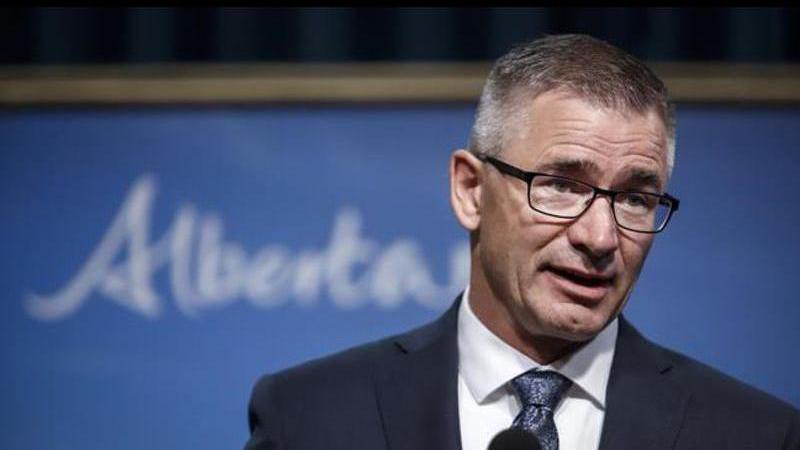
Minister of Finance, President of the Treasury Board, and MLA for Grande Prairie-Wapiti Travis Toews says Budget 2021 is created with the goal of recovering from the COVID-19 pandemic and downturn in the non-renewable resource sector.

Toews says adequately funding health-care is the number one priority in the budget.

“Department of Health’s operating budget is increased by $900-million, or four per cent, from the last budget to $21.4-billion. This increases to $23-billion when amortization and inventory consumption is included.

“And I want to say that this increase is going to be reflected in each of the fiscal years for the duration of the fiscal plan.”

Toews says that increase will help reduce the backlog of surgical wait-times, as well as allow the implementation of Alberta Health Services regulations that were delayed due to the pandemic.

Over $3.5-billion is being invested in continuing care, community care, and home care programs, which represents a $200-million increase from the previous fiscal year. $140-million is being spent over four years to improve mental health services and programs in the province as well, and $143-million is being invested over three years in new health care facilities.

Toews says economic recovery is another key focus in Budget 2021, with the Alberta Government spending $3.1-billion to support the recovery. This will include $1.5-billion over three years on strategic investments in key economic sectors; a $500-million contingency fund for further economic recovery initiatives; and $1.7-billion in infrastructure project investments.

“We are really looking to prioritize projects that will improve our competitiveness and productivity. Projects that will attract additional private sector investment and position Alberta’s economy for long-term recovery and growth.”

Budget 2021 also does not include any new taxes, nor are there tax increases.

Alberta’s net financial debt is now forecast at $62.5-billion for 2020-21, and increasing to $82.2-billion in 21-22, $94-billion in 22-23, and 102.1-billion in the following year. However, those rates are all below the 30 per cent mark in the Net Debt to GDP ratio (20.3 per cent / 24.5 per cent / 26.1 per cent / 26.6 per cent), which Toews says is positive, as 30 per cent is a reasonable ratio at which the province can still reliably pay off it’s debt.

Toews adds Budget 2021 forecasts the West Texas Intermediate (WTI) at $46-US per barrel, which in turn results in the current estimate of an $18.2-billion deficit for 2021-22. He says they have come up with high and low scenarios as well, with the price per barrel at $39 resulting in a $20.1-billion deficit, and a high scenario of $55/bbl resulting in a deficit of $15.4-billion.

He says while a variable WTI will affect the deficit, it will not affect the priorities or decisions made in Budget 2021, which Toews reinforces is investing in health care, economic growth and recovery, and efficiently delivering government services.

Budget 2021 also forecasts the unemployment rate for 2020-21 at 11.4 per cent, and is estimated to drop to 9.9 per cent in the upcoming fiscal year. One of the measures included in Budget 2021 to get Albertans back in the workforce is a $136-million investment in a new Alberta Jobs Now initiative, which is intended to provide training and skill-development programs. Details of Alberta Jobs Now, which Toews says will have federal support, will be released at a future date.