STAY CONNECTED: Have the stories that matter most delivered every night to your email inbox. Subscribe to our daily local news wrap.
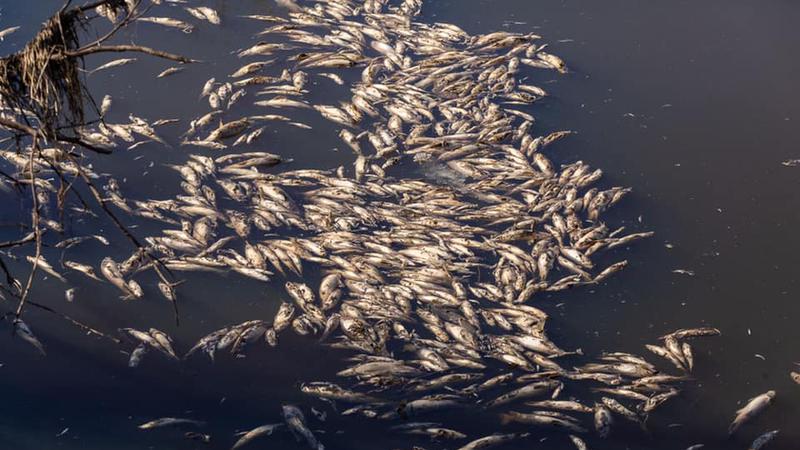
Photographer Marilyn Grubb snapped this shot of the dead fish congregated along Bear Creek earlier this month, which was caused by an event known as winterkill (Photo: Chipabirdee Images by Marilyn Grubb Photography & Digital Art)
Biologist says many fish remain

Winterkill deemed cause of death for mass of fish from Bear Lake

Mar 26, 2021 | 6:32 PM

A Senior Fisheries Biologist with Alberta Fish and Wildlife says the large number of dead fish coming out of Bear Lake and into Bear Creek was caused by an event known as winterkill but adds that there are still plenty of live fish remaining in the lake.

A report of a large swath of dead fish in the outlet of Bear Lake was first reported to Fish and Wildlife on March 12, where Adrian Meinke responded to check out what had happened.

He says after testing some samples from across the lake over the following days, he was able to confirm the fish had died from a lack of dissolved oxygen in the water over the winter, an event known as winterkill.

“There’s a number of factors that come into play that cause (winterkill),” said Meinke to EverythingGP. “(The fish) are more susceptible in shallow lakes, as deeper lakes have the ability to hold more oxygen over the winter.”

He said such factors that lead to a lack of dissolved oxygen in lakes and rivers come from the exchange with the air at the surface of the water being blocked off when the water freezes over.

“That’s one of the primary methods to get oxygen dissolved into that water, is through that interface.”

He says that isn’t the only way oxygen dissolves into the water. He says photosynthesis occurring with plants and algae in the lake from sunlight is also pinched off when ice and snow cover the water, further limiting the ability for oxygen supply to build up.

Meinke says a lake like Bear Lake is a good habitat for fish because of the rich nutrients in the water in the summer, leading to strong growth of vegetation in the lake. But once winter comes along, the ice and snowcap over the lake causing a lack of sunlight leads to many of those plants dying and decomposing in the water.

“There’s bacteria that are responsible for the decomposition,” said Meinke. “But in that process of decomposing the organic matter, the bacteria consume the oxygen out of the water.

“So, you no longer have the interface of air with the water dissolving oxygen, you no longer have the strong sunlight penetrating to the vegetation to create oxygen through photosynthesis, and you have a large amount of organic matter decomposing, which is actually pulling the oxygen out of the water.”

Meinke says from his observations there could still be some fish that are succumbing to low oxygen, and that there are also some already dead fish that have yet to make their way out of the lake.

Though the number of dead fish coming from the lake may look alarming, Meinke adds it surprises many people, there are still many fish alive in the lake, most of which are fish he calls white suckers.

“We have observed hundreds, if not thousands of live fish in the open water area,” said Meinke. “Just kind of hanging out, waiting for the rest of the lake to open up.

“They’re able to get enough oxygen through that air-surface exchange to keep them surviving. They were in good condition.”

He says white suckers are not a sport fish and are not ones that Alberta Fish and Wildlife restock in the lake. However, he says there are enough remaining in the lake to repopulate in short order.

“White suckers do a very good job at managing in fairly tough conditions.”

As the dead and decomposing fish flow out of the lake over the coming weeks, an odour will follow with them. Meinke says that does mean people walking along the creek bank or around the lake should be mindful of wildlife like coyotes, bears and birds looking to feast on the fish.

“There’s a high chance that whatever scavenger, predator, or opportunistic wildlife that are in the area will be jumping at the opportunity because this is early season and there is not a lot of food out there.,” said Meinke. “This is like a smorgasbord of protein for these types of species.”

Meinke adds pollution was not a factor in the deaths of the fish.