STAY CONNECTED: Have the stories that matter most delivered every night to your email inbox. Subscribe to our daily local news wrap.
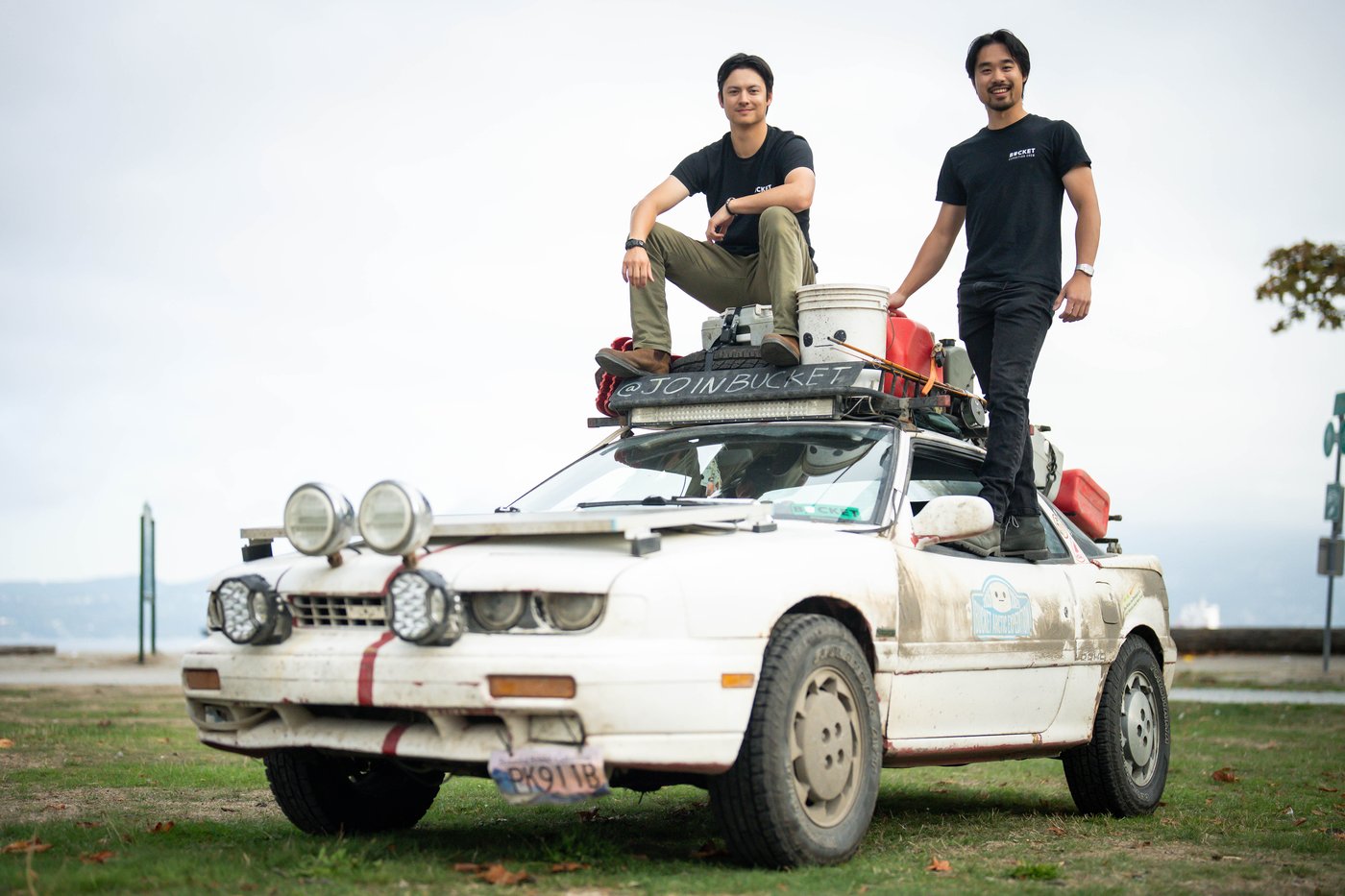
Adam Riddell, left, and Jaden Konishi are pictured with Adam's Isuzu Impulse RS in Vancouver, on Sunday, Sept. 13, 2026. THE CANADIAN PRESS/Ethan Cairns

Clutch moments galore, on friends’ epic road trip from Vancouver to Arctic and back

Sep 18, 2026 | 2:00 AM

VANCOUVER — When Jaden Konishi rolled his 1986 Porsche 944 into Vancouver after an 8,000-kilometre road trip to the Arctic Circle, he had a surplus of new memories but no clutch.

It had died about 3,000 kilometres earlier, somewhere in the Yukon’s Tombstone Territorial Park.

“It’s a part that you can’t replace on the car unless you remove the engine,” he explained.

Konishi and a group of friends have just returned from an epic three-week journey from Vancouver to Tuktoyaktuk, N.W.T., to swim in the Arctic Ocean and test both the limits of their mechanical prowess and the capabilities of six cars that might generously be described as novel choices.

In addition to Konishi’s Porsche, the cars chosen for the trip to the northernmost community on mainland Canada accessible by public road were a 1991 Isuzu Impulse RS, a 1993 Nissan 240SX, a 1989 Toyota MR2 Supercharged, a 1990 Mazda Miata and a 1994 Dodge B350.

Konishi said they planned for about a year and each driver had the skills to care for their own vehicle in an emergency. They shared tools, carrying everything from spare parts to a welder.

Fixes weren’t always an option. In the case of his Porsche’s clutch, Konishi relied on the starter motor to get the classic sports car moving and then used a method called “floating” the gears to shift without using the clutch.


 “It’s not that he couldn’t come to a stop. His brakes and stuff work, of course. It’s just when he comes to the stop, his engine would shut off,” friend Adam Riddell recalled.

“So, there were many times where he would just be doing a circle in the parking lot, or he’d just keep turning right, if we didn’t know where we were going or trying to figure something out, because he couldn’t come to a stop on a hill or anything, or else the car would not be able to start again until he got to flat ground.”

Part of the challenge was returning the vehicles home under their own power, after traversing the Dempster Highway, the unpaved 740-kilometre route from Dawson City, Yukon, to the Arctic Ocean. All succeeded.

“We grew up watching shows like Top Gear, where they take sports cars or unconventional cars to do crazy road trips. And we’ve done a few in the past, but the Dempster is kind of this looming monster that we wanted to tackle,” Riddell said, describing his friends as “car guys” who wanted to see what they could accomplish.

Every year thousands of tourists make the drive to Tuktoyaktuk on a route that can challenge modern cars.

Konishi maintains that the group’s older vehicles — which had been retrofitted into makeshift campers, with a rooftop tent or the removal of seats — are simpler and easier to fix than modern vehicles with computers or complex parts.

“There were Jeeps and trucks and semis and all sorts of modern vehicles that do this drive and are meant for it that were on the side of the road that had to get towed out,” he said.

“It really just goes to show, no matter how much you prep and no matter what you buy, things are going to happen.”

The group documented their mechanical woes.

The Impulse leaked coolant. The 240SX lost a headlight and had its exhaust fall off multiple times. The MR2 wore through six tires and had blown front struts, while the Miata lost both its accessory belts. As for the Dodge B350, it suffered a laundry list of issues — batteries fell out, rotors warped, the transmission overheated and the dash rattled apart.

One of the larger bumps in the road came when the group had to cross the Peel River, which had flooded, making the ferry inoperable.

The group waited in line, sleeping one night in their cars, while workers rebuilt the banks.

Konishi and Riddell said arriving in Tuktoyaktuk was “surreal.”

‘Adam and I didn’t think that all the vehicles would make it. We thought that maybe one or two of the cars would probably be left somewhere, and then we’ll go back for it and drag it out on the way home,” Konishi said.

“So, to see all of them there, all these old cars at the sign, it really was spectacular.”

And the swim?

“Actually, getting into the ocean kind of put that dreaminess away, as it was so cold,” Riddell said.

It was the people they met who provided the biggest lesson, Konishi said.

They took shelter in the ferry workers’ compound because of a bear in the area, ate smoked whitefish from a resident, and were loaned a hydraulic press in Whitehorse for repairs.

“A lot of the people that we met around Whitehorse and in Yukon and on the Dempster, we would see them as we’re driving the highway, and everybody is going at their own pace,” he said.

“Some people have already made it; they’re on their way back. Some people are going up, and we pass their camp. But every time we’d be able to stop and chat and share stories, and it really felt like going on a backpacking trip, but with cars.”

The group documented the trip and plan to release a film on YouTube next month.

“This trip was not about efficiency or ease. It was about a group of friends banding together to work through the many issues we encountered along the way to achieve our shared goal. Surprisingly, no flats!” Konishi said in a social media post last week celebrating their successful return to Vancouver.

This report by The Canadian Press was first published Sept. 18, 2026.

Ashley Joannou, The Canadian Press